


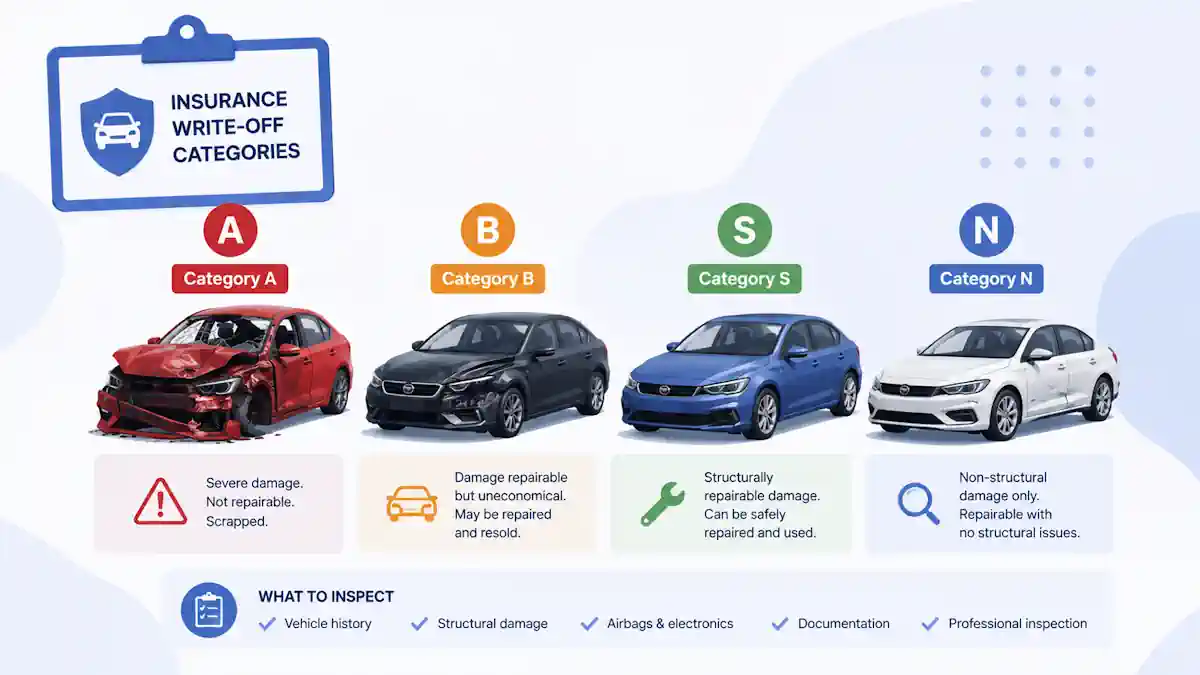
An insurance write-off is a vehicle that an insurer has decided not to repair, usually because repairing it would be unsafe or uneconomical. Some written-off cars can be repaired and sold legally, but the category affects whether the vehicle may return to the road and what buyers should investigate.
Category A and Category B
Category A vehicles must be crushed in their entirety. No parts may be recovered for reuse. Category B vehicles must also never return to the road, although some serviceable parts may be recovered before the body shell is destroyed.
A car offered for normal road use should not carry either category. Treat conflicting identity or history information as a serious warning and do not proceed until it has been resolved.
Category S structural damage
Category S means the vehicle suffered damage to a structural part of its frame or chassis. It may return to the road after being properly repaired, but the category does not confirm the quality or safety of that repair.
Ask for photographs taken before and during the work, parts invoices and evidence of any body-alignment measurements. Arrange an independent inspection by a suitably qualified engineer or vehicle inspector with experience of repaired structural damage.
Category N non-structural damage
Category N means the insurer did not classify the damage as structural. It does not mean that the damage was minor or merely cosmetic. Steering, suspension, braking, electrical and other safety-critical systems may still have been affected.
Look beyond the label
Write-off categories record the insurer's assessment of the vehicle before any subsequent repair. They do not certify the standard of that repair.
Check for warning lights, uneven panel gaps and unusual tyre wear. Ask for evidence that affected safety and driver-assistance systems were inspected and that any required calibration was completed. A valid MOT certificate alone does not prove that the repairs were completed to an appropriate standard.
What about Categories C and D?
Categories S and N replaced Categories C and D in October 2017. A vehicle written off under the earlier system retains its original category.
Category C generally meant that the estimated repair cost exceeded the vehicle's pre-accident value. Category D meant that the estimated repair cost was lower than its value, but other considerations made an insurer-funded repair uneconomical. Neither category describes whether the damage was structural, so the original damage and repair evidence remain important.
Before buying a written-off car
Confirm the category with a vehicle history check and compare it with the seller's description. Obtain an insurance quote before purchasing, disclose the write-off category when asked and check whether the insurer will apply any special conditions.
Compare the asking price with equivalent vehicles and account for potentially higher insurance costs and a lower resale value.
Walk away if the seller cannot explain the damage or provide convincing repair evidence. A lower price is worthwhile only when the car is safe, insurable and accurately represented.