

Vehicle history check FAQs
Understand your report and get help using Check-Buy-Drive. Search the answers below, or follow the examples into our sample report.
12 answers
Why does the car I bought still show a taxi licence?
Taxi and private hire vehicle licences are usually issued for 12 months. A report shows the licensing period supplied in the records; it does not establish that the vehicle was used as a taxi throughout that time. For example, a licence might run from 15 March 2023 to 14 March 2024, but the owner could sell the car on 20 December 2023. The original licensing dates may still appear after the sale. We display the supplied licensing information rather than changing the dates to match a change of owner. If you believe a record is incorrect, contact us with the registration and report details so we can investigate.
Reading the taxi licensing section
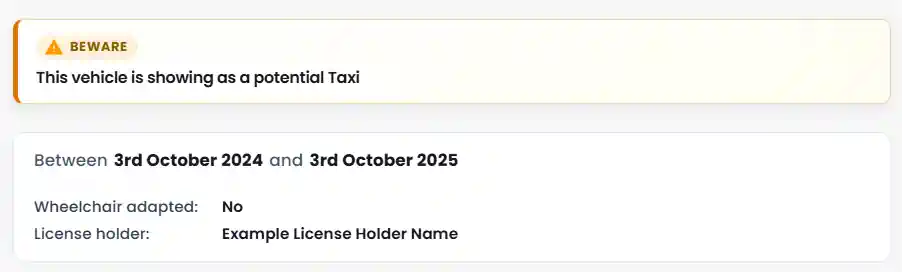
- Start date: When the recorded licensing period began. This is not the date you bought the car.
- Expiry date: The end of the recorded licensing period. A sale before this date does not change the original period shown.
- Licence holder: The holder named in the supplied licensing record, where available. This does not establish who owns the vehicle now.
Licensing guidance: GOV.UK vehicle licences for taxis and private hire vehicles.
Why can a car have salvage history without an insurance write-off?
Salvage auction records and insurance write-off records are separate sources of information. A vehicle can appear at a salvage auction without a corresponding insurance write-off being recorded in the data available to us. Read both parts of the damage section, including any available photographs and descriptions. No recorded write-off does not mean a vehicle has never been damaged, and a history report cannot assess repair quality. Arrange an independent inspection if you have concerns.
Reading the damage and salvage sections
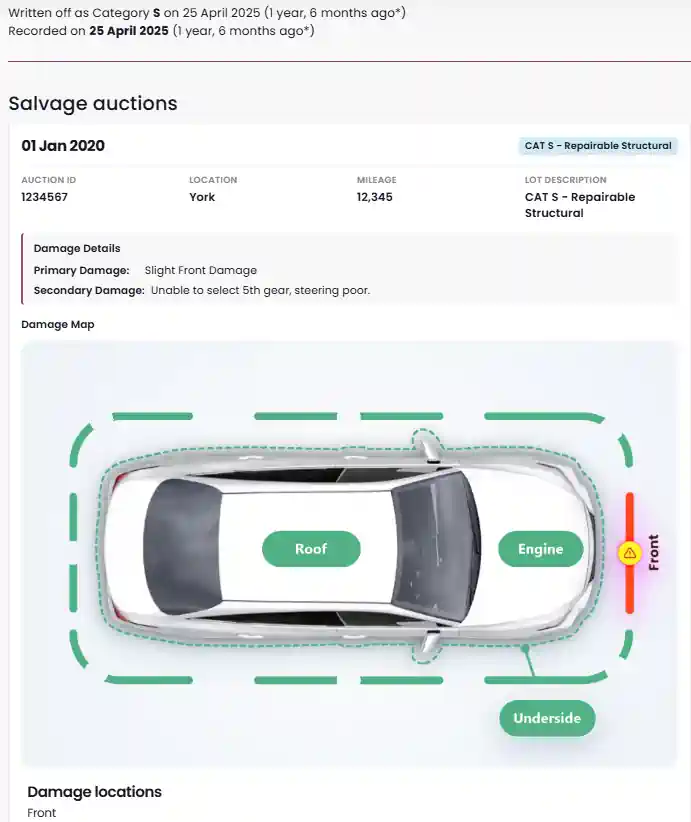
- Insurance write-off result: Read the insurance result separately from the auction history. No recorded write-off does not establish that the vehicle has never been damaged.
- Salvage auction record: Review the available auction details and photographs. An auction record can exist without a corresponding insurance write-off record.
- Photographs and descriptions: These describe the recorded auction, not necessarily the car's current condition. Ask for repair evidence and arrange an inspection where needed.
What does an outstanding finance result mean?
It means the supplied records identify a finance agreement associated with the vehicle. Review the agreement details shown and ask the seller and finance provider to clarify its status before proceeding. A report reflects the information available when the check was made; it is not proof that an agreement has since been settled.
Reading the finance section
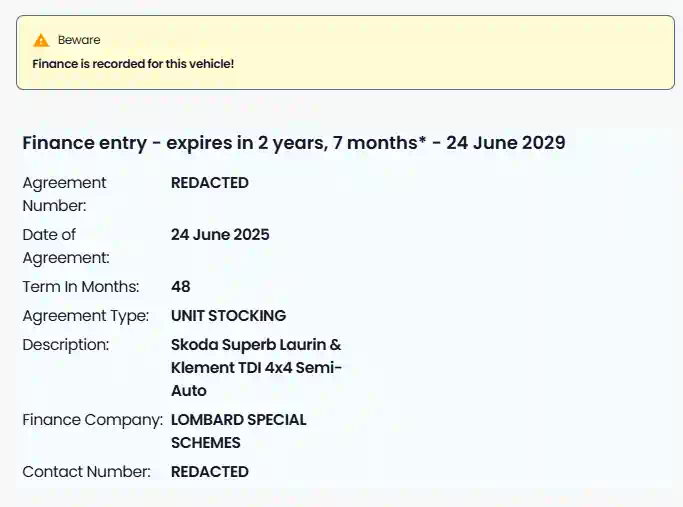
- Finance result: Read the status before reviewing individual agreement entries.
- Agreement details: Compare the agreement date, type and term with the seller's information.
- Finance company: Use the provider details to clarify the agreement's current status before proceeding.
Does a mileage discrepancy always mean a car has been clocked?
An unexpected reading needs investigation, but does not by itself prove deliberate mileage alteration. Recording errors, different units or an instrument replacement can also cause inconsistencies. Compare the dated readings with MOT records, service invoices and the current odometer, and ask the seller to explain any differences.
Reading the mileage section
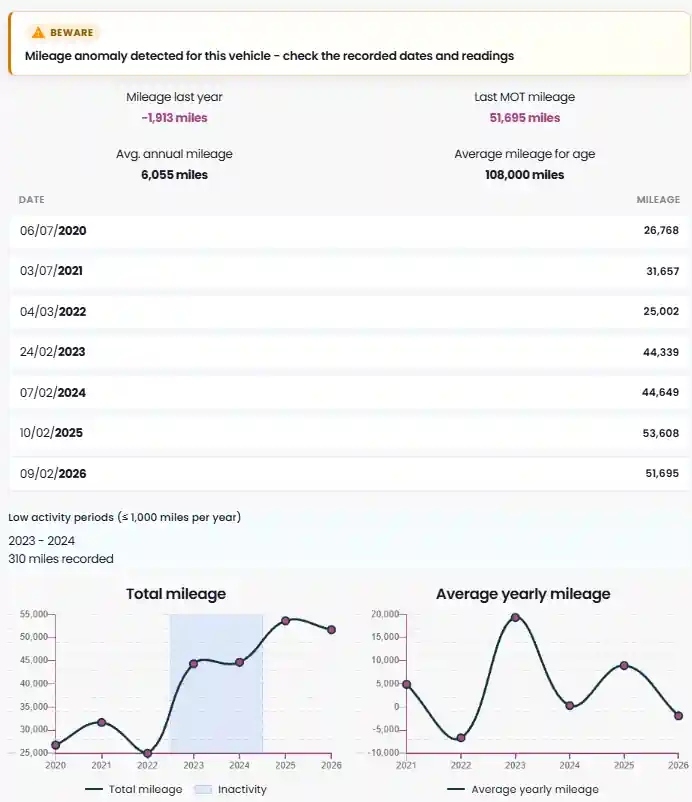
- Date and mileage: Read the entries in date order. Investigate a reading that is lower than an earlier one rather than assuming the cause.
- Last MOT mileage: This is a recorded test reading, not a live odometer reading. Compare it with the car's current odometer and service records.
- Average annual mileage: Use this summary alongside the individual readings. An average can conceal a gap or an unusual entry.
How should I use the MOT history in my report?
Look at the sequence of tests, failures, advisories and recorded mileages. Repeated advisories can help you identify areas to inspect and discuss with the seller. An MOT records the test outcome at that time; a past pass does not guarantee the vehicle's present condition or replace an inspection.
Reading the MOT history
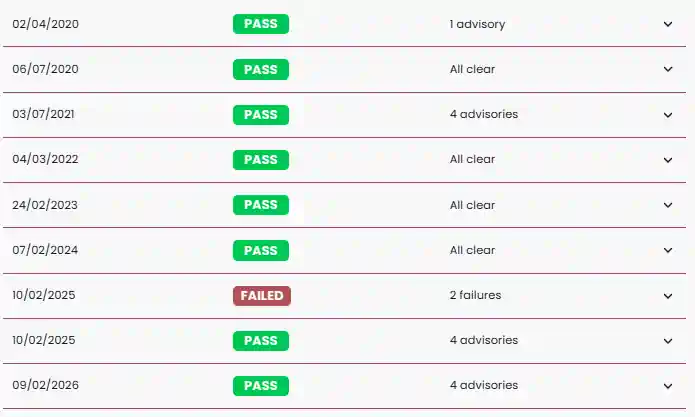
- Test date and result: Check when the test took place and whether it passed or failed.
- Recorded mileage: Compare the reading with earlier tests and the mileage section.
- Failures and advisories: Use the recorded issues to guide questions about repairs and maintenance.
What should I do if a report shows a stolen record?
Read the status and details carefully and do not proceed with a purchase until the issue has been clarified. Contact us if you need help understanding the result. A clear result means no matching stolen record was returned by that check, rather than proof of ownership or a guarantee that every theft has been recorded.
Reading the stolen vehicle check

- Status: Read the result and any explanatory message together.
- Available records: Review the source and details shown. Missing data does not establish ownership.
- Next steps: If a stolen record is shown, clarify the issue before proceeding with a purchase.
How do I get a vehicle history report?
Enter the vehicle registration on the site and check that the vehicle details match. Choose the check you need and follow the checkout instructions. Compare the available packages before purchasing, as the information included varies by check.
Compare checks and included information Link to this answerWhat information is included in a report?
Coverage depends on the check you choose and the records available for the vehicle. Reports can include MOT and mileage history, insurance write-offs, salvage records, finance, stolen status and taxi licensing information. The sample illustrates a full report; it does not promise that every vehicle will have records in every section.
Explore the full sample report Link to this answerWhere can I find my purchased report?
Your report is displayed online once processing is complete. Sign in to the account used for the purchase to find your reports again. If a report is missing or will not load, contact us with the registration and purchase details so we can investigate.
Go to your account Link to this answerHow do I use an unused check?
Sign in to the account holding your unused checks, then start a check for the vehicle registration you want to search. Follow the available redemption options for your check type. If an unused check is missing from your account, contact us with your purchase details.
View your unused checks Link to this answerWhy is information missing or different from another report?
Sources differ in their coverage and update times. A section may have no available data, or may not be included in the package you purchased. Neither means that the vehicle has no history. Check the section's explanation and the report date, and contact us if you think something is wrong.
Ask about a report record Link to this answerWhat if there is a problem with my report or I want a refund?
Contact us with your registration, report or order reference, and a description of the issue. We can investigate missing or disputed information. Refund eligibility is explained in our refund policy; please read it for the conditions that apply to your purchase.
Read the refund policy Link to this answerStill need help? Contact our team.