






Car Insurance Group Checker

Wondering what insurance group a car sits in? Find out instantly by registration. We reveal the ABI insurance group rating, explain what it means for your premium, and help you budget before you buy. Uncover the car, discover the truth.

View Sample Report
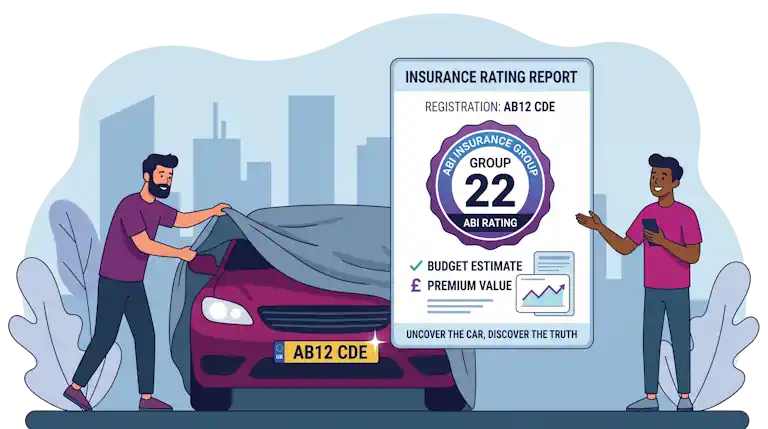
Illustration of a car insurance group check
🔒 Compare Insurance Before You Buy
Ad
🔍
Compare Insurance

Browse all insurance types on Quotezone

Get a Quote
checkbuydrive.com is an affiliate partner of Quotezone.co.uk (operated by Seopa Ltd, FCA FRN: 313860). We do not provide financial advice. We may receive a commission when you click through or purchase insurance through our partners.

What are car insurance groups?

Every car sold in the UK is assigned an insurance group from 1 to 50 by Thatcham Research on behalf of the Association of British Insurers (ABI). This single number summarises how risky the vehicle is to insure — and directly influences your premium.

LOW GROUPS — 1 TO 10
Budget-Friendly to Insure

Smaller, more affordable cars with modest performance and low repair costs typically land here. These are popular choices for new drivers, students, and anyone looking to keep annual premiums manageable.

Key focus: lowest premiums & entry-level vehicles

MID GROUPS — 11 TO 30
Mainstream Family Cars

The majority of popular hatchbacks, SUVs, and estate cars sit in this range. Moderate performance, reasonable parts pricing, and solid safety features keep premiums at a fair level for everyday driving.

Key focus: balanced cost & everyday practicality

HIGH GROUPS — 31 TO 50
Premium & High-Performance

Sports cars, luxury vehicles, and high-spec models with expensive parts, powerful engines, and specialist repair requirements land in the top tiers. Expect significantly higher annual premiums.

Key focus: highest premiums & specialist repairs

Why check the insurance group before you buy: Two versions of the same car — differing only in trim or engine — can sit in completely different insurance groups. A Check‑Buy‑Drive report reveals the exact ABI group for the specific vehicle you're considering, so you can factor the true running cost into your decision and avoid an unpleasant surprise when renewal time comes around.

What determines an insurance group?

Thatcham Research scores every vehicle across a range of criteria to arrive at a single group rating. Understanding these factors helps you make smarter choices.

Vehicle Price
New car value
Higher price → higher group

The more a car costs new, the more it costs to repair or replace after a claim. Expensive vehicles naturally attract higher group ratings.

Performance & Power
Engine output & top speed
More power → higher group

Cars with higher bhp, faster acceleration, and greater top speeds are statistically more likely to be involved in claims, pushing them into higher groups.

Repair Costs & Times
Parts & labour
Costlier repairs → higher group

Specialist components, complex bodywork, and long lead times for parts all increase the insurer's potential payout, raising the group rating.

Safety Features
Crash test & driver aids
Better safety → lower group

Advanced braking, stability control, autonomous emergency braking, and strong Euro NCAP scores reduce claim severity and can lower the group.

Security Features
Theft protection
Stronger security → lower group

Factory-fitted immobilisers, tracking systems, and Thatcham-approved alarms reduce the risk of theft and can improve the group rating.

Trim & Specification
Model variants
Same car, different group

Two versions of the same model with different engines or trim levels can sit many groups apart. Always check the specific variant you're considering.

Check a car's insurance group in three steps

Instant, independent vehicle checks powered by live official UK vehicle data.

01
Enter the registration

Type any UK registration plate into the search bar above to start a free, comprehensive vehicle history inspection.

02
View the insurance group

We reveal the exact ABI insurance group (1–50) for that vehicle, along with the typical range for the model and what the number means for your premium.

03
Review the full history report

Beyond insurance group, explore MOT history, tax status, mileage records, write-off status, and outstanding finance — all in one report.

Insurance groups — frequently asked questions

Clear, expert answers to the most common questions about car insurance groups, premiums, and what affects your insurance cost.

What is a car insurance group?

A car insurance group is a rating from 1 to 50 assigned by Thatcham Research on behalf of the Association of British Insurers (ABI). It summarises how expensive a vehicle is likely to be to insure based on factors such as repair costs, parts pricing, performance, safety, security, and the car's original value. Group 1 represents the cheapest cars to insure, while group 50 covers the most expensive. Insurers use this group as a core input when calculating your premium.

Is an insurance 'band' the same as an insurance group?

Yes — the terms 'band' and 'group' are used interchangeably to describe the same ABI 1–50 scale. Do not confuse insurance groups with car tax bands, which are set by the government based on CO2 emissions and are a completely separate system.

How much difference does the insurance group actually make to my premium?

The insurance group is one of the most significant factors insurers consider. While your personal circumstances — age, location, claims history, and no-claims discount — also play a major role, a car in group 40 will typically cost substantially more to insure than an identical driver insuring a group 10 vehicle. Always check the group before committing to a purchase.

Can I check the insurance group of a used car?

Yes. You can check the insurance group of any used car by entering its registration number into a Check‑Buy‑Drive report. Whether you're buying from a dealer or a private seller, knowing the insurance group helps you estimate ongoing costs and make an informed decision before exchanging money.

Why do two versions of the same car have different insurance groups?

Insurance groups are assigned per model variant, not per make and model alone. Differences in engine size, power output, trim level, and optional equipment can push one variant into a significantly higher group than another. For example, a base-model hatchback might sit in group 12, while the same car with a sportier engine and higher specification could land in group 22.

What is the cheapest insurance group?

Group 1 is the lowest and cheapest insurance group. Cars in this group are typically small, affordable, easy to repair, and have modest performance. They are popular choices for new drivers, young motorists, and anyone looking to minimise insurance costs. Examples include entry-level city cars and small hatchbacks.

Can I lower my car's insurance group?

You cannot change the insurance group of a specific vehicle — it is fixed by Thatcham Research based on the car's specifications. However, you can choose a lower-group variant of the same model when buying, or consider a different model altogether. Adding a Thatcham-approved tracking device may not change the group but can reduce your premium.

Does a higher insurance group always mean higher premiums?

Generally, yes — but your personal circumstances matter just as much. A young driver insuring a group 1 car may still pay more than an experienced driver with a strong no-claims discount insuring a group 30 vehicle. The group sets the vehicle's side of the equation; your personal profile determines the rest.

How are insurance groups decided?

A specialist panel of members from the Association of British Insurers assigns groups based on detailed vehicle and technical data collected and analysed by Thatcham Research. Each car is scored across multiple criteria — including price, performance, safety, security, and repair costs — and then placed into the most appropriate group from 1 to 50.

Why is a vehicle history check important alongside an insurance group check?

A Check‑Buy‑Drive history check goes far beyond insurance group. It reveals recorded write-off status (Cat S or Cat N), MOT failure and advisory history, outstanding finance agreements, mileage discrepancies, and import/export records. Combined with the insurance group information, you get a complete picture of the vehicle's true cost and risk before you buy.

No registration yet? No problem.
Buy report credits to use or share later

Buy now and keep your report credits for when you find the right vehicle — or send a check link to someone else.

Use when you're ready
Share with a friend or family member
Buy report credits

What Our Report Reveals

Comprehensive Vehicle Details

Our report provides essential information about the vehicle, including its make, model, year of manufacture, body type, fuel type, engine specifications, and transmission. This ensures the car's declared specifications match the actual details, giving you a clear picture of what you're buying.

Vehicle illustration

Our data comes from reliable sources such as the DVLA and UKVD.

We check for writeoffs, mileage clocking, and other issues.

VOSA MOT logo DVLA logo Vehicle Data Global logo

Choose Wisely

Ensure your next vehicle is a reliable companion for your journeys.
Save Valuable Time
Save Valuable Time

Skip countless test drives and wasted hours. Filter through offers efficiently by knowing the vehicle's true condition upfront.

Avoid Costly Mistakes

Access the full vehicle history to ensure you're not buying a money pit. Our comprehensive reports uncover hidden issues before they become your problem.

Negotiate a Better Deal

Once you find your dream vehicle, use the detailed information from our report to confidently negotiate a fair and lower price.

Did you know?

Grey has been the UK's most popular new car colour for seven years running — making up nearly 28% of new registrations.

CBD · 2024 · Open Government Licence v3.0

The UK used car market sees over 7.6 million transactions every year — that's one used car sold every 4 seconds.

CBD · 2024 · Open Government Licence v3.0

Nearly 6 in 10 cars on UK roads still run on petrol — electric vehicles make up just 3.7% of the fleet.

DfT · end 2024 · Open Government Licence v3.0

There are now over 1.39 million zero emission vehicles on UK roads — a 37% increase in a single year.

DfT · end 2024 · Open Government Licence v3.0

Over 80% of insurance write-offs — Categories S and N — can legally return to the road after repair.

CBD · 2023 · Open Government Licence v3.0

Your Vehicle History Report

Want to avoid unpleasant surprises?

Check the vehicle history before buying!

Enter the REG and see a detailed report that will help you make a confident decision.

Have Questions? We're here to help

Get the support you need, precisely when you need it. Simply send us a message, and our dedicated team will get back to you with answers.

Illustration of two people shaking hands

The Check Buy Drive blog

Latest from the blog

News, stories and practical ideas for buying, checking and owning a car.

Check Buy Drive logo
© 2026 - Check. Buy. Drive. - All rights reserved.
An unhandled error has occurred. Reload 🗙